Proper Course
Monday, June 17, 2013
Saturday, June 15, 2013
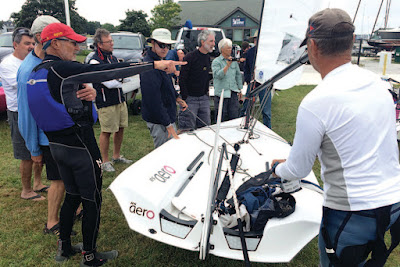
Where am I?
Where am I ?
Clues...
1. I have been boating on the waterway in the photo, although not in this exact spot, and did write about that experience on this blog.
2. The name of the establishment we are at is something sailors should know about.
3. Toto, I've a feeling we're not in Rhode Island any more.
Friday, June 14, 2013
Best Father's Day Card Ever
Last July, my son and I took his two eldest kids, Emily (then 6) and Aidan (4) sailing on our Lasers for the first time.
This week at pre-school Aidan drew this picture for his Dad for Father's Day.
Do you think we might have someone else in the family already hooked on sailing?
This week at pre-school Aidan drew this picture for his Dad for Father's Day.
Do you think we might have someone else in the family already hooked on sailing?
Thursday, June 13, 2013
Zen and the art of coming full circle
I feel like I'm coming full circle.
When I first started sailing in England, I raced my Laser at my local club on Taplow Lake, near Slough.
Then some of my fellow Laser fleet members persuaded me to go to some local "open meetings" (which is real English for what are called "regattas" in American.) But we only sailed one day events and never more than an hour's drive from our home base.
Then I moved to Rutland which is as near to heaven as you will find on this earth. I sailed in the Laser fleet at Rutland Sailing Club. My two sons learned to sail in Optimists there. I never felt the need to travel anywhere else to sail, except in my last year in England when I did travel to the UK Laser Masters, a two day event on the south coast, at Swanage.
In 1989 we moved to New Jersey. I shipped a Laser and two Optimists to NJ with our furniture. The problem we discovered was that there was hardly any Optimist or Laser sailing near where we lived in North Jersey. At first we sailed our Laser and Optimists every week in the summer in the local club in Mountain Lakes in the "open" fleet. But handicap racing wasn't as much fun as one design racing so I also started racing Sunfish, which is what everyone else in our club and in that area of the state raced.
But I was itching for some real competition in Lasers so I started to travel to Laser regattas on the Jersey Shore and in Pennsylvania. And then further afield to Maryland and Virginia and New York and even to Canada. I did some longer regattas lasting several days. Usually my wife and kids came with me on the longer trips and we did a bit of exploring in combination with the regattas.
I was racing Sunfish a lot too on the local circuit in North Jersey. Then one day I read an article by Brian Weeks in the Sunfish class newsletter that basically said, "Even you, yes even a duffer like you Tillerman, can qualify for the Sunfish Worlds." That was intriguing so I thought I would give it a shot. Apparently the way to qualify for the Sunfish Worlds was to sail Sunfish Regionals and/or the Sunfish North Americans and if you did well enough you would get selected for the Sunfish Worlds.
By this time the family owned three Lasers and three Sunfish. In the summer of 1995 my sons and I traveled to Ithaca, NY with three Lasers for a one week clinic with Gary Bodie. And the next week we traveled to Lewes, DE with three Sunfish to sail in the Sunfish North Americans.
I think I finished just inside the top 40 at the Sunfish NAs, so imagine my surprise when, a few months later, I received a letter from the Sunfish Class Office inviting me to sail in the 1996 Sunfish Worlds in the Dominican Republic. So my wife and I went off to the DR for a week so I could sail in the Sunfish Worlds and we had a wonderful time. And the next year I was invited to go to the Sunfish Worlds again (based on that top 40 finish at the NAs in 1995 again as far as I could tell) and we went to Cartagena in Colombia for the 1997 Sunfish Worlds, which was an eye-opening experience.
You see where this story is going? As time goes on I was traveling more and more, and further and further, to go to longer and longer regattas. It was all a lot of fun.
I was also sailing various Laser Masters regattas around North America, so I thought why not go to the Laser Masters Worlds? The Sunfish Worlds had been fun; Lasers could only be more fun. Tillerwoman and I went to Mexico in 2000 for the Laser Masters Worlds where I was humbled by the high standard of competition but still enjoyed myself. I had got the bug. We traveled to Australia for the Laser Masters Worlds one year and to Spain for Masters Worlds a couple of times too. I started going to Laser clinics in places like Florida and the Dominican Republic. I was one of the globe-trotting old Laser geezers and was starting to make friends with Laser sailors all over the world. I was also driving 3 or 4 hours every Sunday in the winter to sail in the Laser frostbite fleet at Cedar Point YC in Connecticut.
Then I moved to Rhode Island, which is even more like heaven than Rutland.
I didn't realize at first how lucky I was.
From May to October there is usually some Laser regatta every weekend somewhere in New England, often less than an hour's drive from my house. From November to April there is Laser frostbiting every Sunday in Newport, only about 40 minutes drive from my house. And for many months of the year I can go somewhere during the week any day I feel like it and just sail my Laser on the sea by myself.
It's starting to feel like I am back where I started in England. There is more than enough opportunity to sail and race my Laser close to home. It's not like when I was in New Jersey and I had to travel some distance to find any real Laser competition.
As a result I am finding that I am losing my urge to travel very far to Laser regattas. Driving and flying are definitely not my favorite occupations. Why spend a whole day driving to Canada or Virginia (and another whole day driving back) when I could race somewhere much closer to home? Why stay in some crummy motel when I could do a three day regatta down the road and sleep in my own bed every night? And why bother with the expense and hassle to travel to some international regatta on the other side of the world? I am beginning to forget why I ever did.
It feels a little unadventurous.
It feels a little lazy.
But it feels right.
It feels like I've come full circle.
If you are a racing dinghy sailor, did you ever get the travel bug as bad as I did?
If you had the travel bug, did you ever lose it?
Do you like sleeping in your own bed?
When I first started sailing in England, I raced my Laser at my local club on Taplow Lake, near Slough.
Then some of my fellow Laser fleet members persuaded me to go to some local "open meetings" (which is real English for what are called "regattas" in American.) But we only sailed one day events and never more than an hour's drive from our home base.
Then I moved to Rutland which is as near to heaven as you will find on this earth. I sailed in the Laser fleet at Rutland Sailing Club. My two sons learned to sail in Optimists there. I never felt the need to travel anywhere else to sail, except in my last year in England when I did travel to the UK Laser Masters, a two day event on the south coast, at Swanage.
In 1989 we moved to New Jersey. I shipped a Laser and two Optimists to NJ with our furniture. The problem we discovered was that there was hardly any Optimist or Laser sailing near where we lived in North Jersey. At first we sailed our Laser and Optimists every week in the summer in the local club in Mountain Lakes in the "open" fleet. But handicap racing wasn't as much fun as one design racing so I also started racing Sunfish, which is what everyone else in our club and in that area of the state raced.
But I was itching for some real competition in Lasers so I started to travel to Laser regattas on the Jersey Shore and in Pennsylvania. And then further afield to Maryland and Virginia and New York and even to Canada. I did some longer regattas lasting several days. Usually my wife and kids came with me on the longer trips and we did a bit of exploring in combination with the regattas.
I was racing Sunfish a lot too on the local circuit in North Jersey. Then one day I read an article by Brian Weeks in the Sunfish class newsletter that basically said, "Even you, yes even a duffer like you Tillerman, can qualify for the Sunfish Worlds." That was intriguing so I thought I would give it a shot. Apparently the way to qualify for the Sunfish Worlds was to sail Sunfish Regionals and/or the Sunfish North Americans and if you did well enough you would get selected for the Sunfish Worlds.
By this time the family owned three Lasers and three Sunfish. In the summer of 1995 my sons and I traveled to Ithaca, NY with three Lasers for a one week clinic with Gary Bodie. And the next week we traveled to Lewes, DE with three Sunfish to sail in the Sunfish North Americans.
I think I finished just inside the top 40 at the Sunfish NAs, so imagine my surprise when, a few months later, I received a letter from the Sunfish Class Office inviting me to sail in the 1996 Sunfish Worlds in the Dominican Republic. So my wife and I went off to the DR for a week so I could sail in the Sunfish Worlds and we had a wonderful time. And the next year I was invited to go to the Sunfish Worlds again (based on that top 40 finish at the NAs in 1995 again as far as I could tell) and we went to Cartagena in Colombia for the 1997 Sunfish Worlds, which was an eye-opening experience.
You see where this story is going? As time goes on I was traveling more and more, and further and further, to go to longer and longer regattas. It was all a lot of fun.
I was also sailing various Laser Masters regattas around North America, so I thought why not go to the Laser Masters Worlds? The Sunfish Worlds had been fun; Lasers could only be more fun. Tillerwoman and I went to Mexico in 2000 for the Laser Masters Worlds where I was humbled by the high standard of competition but still enjoyed myself. I had got the bug. We traveled to Australia for the Laser Masters Worlds one year and to Spain for Masters Worlds a couple of times too. I started going to Laser clinics in places like Florida and the Dominican Republic. I was one of the globe-trotting old Laser geezers and was starting to make friends with Laser sailors all over the world. I was also driving 3 or 4 hours every Sunday in the winter to sail in the Laser frostbite fleet at Cedar Point YC in Connecticut.
Then I moved to Rhode Island, which is even more like heaven than Rutland.
I didn't realize at first how lucky I was.
From May to October there is usually some Laser regatta every weekend somewhere in New England, often less than an hour's drive from my house. From November to April there is Laser frostbiting every Sunday in Newport, only about 40 minutes drive from my house. And for many months of the year I can go somewhere during the week any day I feel like it and just sail my Laser on the sea by myself.
It's starting to feel like I am back where I started in England. There is more than enough opportunity to sail and race my Laser close to home. It's not like when I was in New Jersey and I had to travel some distance to find any real Laser competition.
As a result I am finding that I am losing my urge to travel very far to Laser regattas. Driving and flying are definitely not my favorite occupations. Why spend a whole day driving to Canada or Virginia (and another whole day driving back) when I could race somewhere much closer to home? Why stay in some crummy motel when I could do a three day regatta down the road and sleep in my own bed every night? And why bother with the expense and hassle to travel to some international regatta on the other side of the world? I am beginning to forget why I ever did.
It feels a little unadventurous.
It feels a little lazy.
But it feels right.
It feels like I've come full circle.
If you are a racing dinghy sailor, did you ever get the travel bug as bad as I did?
If you had the travel bug, did you ever lose it?
Do you like sleeping in your own bed?
Labels:
Frostbiting,
Regattas,
Rhode Island,
Sunfish
Wednesday, June 12, 2013
Two Styles of Laser Roll Tack
Check out these two very different styles of roll-tacking a Laser, the first by an unnamed German sailor (I assume from the GER on his sail) and the second by Andrew Scrivan who sails in Connecticut.
How are they different?
What can we learn from them?
Which style would be more effective?
The thing that struck me the most was the different ways the sailors time and initiate the initial roll to windward.
The German sailor moves his butt out to the edge of the deck almost as soon as he starts steering into the tack. His boat is heeling to windward as he is steering up to head-to-wind.
Whereas Andrew doesn't move his body at all as he starts to steer, and his boat is flat as he steers up to head-to-wind. In fact the first move he makes is to shift his butt towards the centerline of the boat, and then follows that with throwing his shoulders back to initiate the roll to windward when he is pointing approximately head-to-wind.
What do you think?
Are there any other significant differences?
Labels:
Boat handling
Tuesday, June 11, 2013
Stuckness and the Art of Boat Trailer Maintenance
A couple of weeks back I decided to do a bit of minor maintenance on my boat trailer the day before heading off to a regatta in New Hampshire. Unfortunately I am not good at anything practical or mechanical. So, in the process, I managed to make the electrical problem with the lights on my trailer far worse that it was when I started, and managed to introduce a new issue with one trailer bearing that wasn't there before.
Robert Pirsig wrote about this many years ago in his classic book Zen and the Art of Motorcycle Maintenance. I wasn't very old when I first read the book, but I felt he was talking about me when he addressed the issue of "stuckness." From an early age I have been an expert at creating stuckness and being frustrated by it.
Using an example from motorcycle maintenance, Pirsig explains the essence of stuckness...
I've been there so many times. I had a wiring problem. I tried one thing to fix it and broke something. I tried something else to fix it and broke something else. This is always the way when I try to fix something. Eventually I end up with a worse situation than when I started, without the right part, or the right tool or, more often, without any clue as to what to do next.
Stuck.
Back to his motorcycle example, Pirsig writes...
Exactly!
I have what is effectively a small sledge hammer in my tool box. It's amazing how many times I reach for it in such moments of frustration. If something is stuck, surely beating it with a hammer will unstick it?
It's not that I'm stupid or incapable of rational thought. It's just that my brain freezes up in situations like this.
I am also a very impatient person. When I get stuck I become even more impatient.
I should have learned by now that the secret in such situations is to take a deep breath, slow down, go for a walk, have a beer, maybe sleep on it, and eventually a solution to unstick the stuckness might appear.
But often it doesn't.
Pirsig says...
I don't begin to understand what those last two paragraphs mean.
I didn't understand them when I first read them almost 40 years ago. And I don't understand them now.
If I did understand them, I might be a much better person.
If I did understand them, I guess I might not have missed the regatta because of my bloody trailer problems.
Robert Pirsig wrote about this many years ago in his classic book Zen and the Art of Motorcycle Maintenance. I wasn't very old when I first read the book, but I felt he was talking about me when he addressed the issue of "stuckness." From an early age I have been an expert at creating stuckness and being frustrated by it.
Using an example from motorcycle maintenance, Pirsig explains the essence of stuckness...
A screw sticks, for example, on a side cover assembly. You check the manual to see if there might be any special cause for this screw to come off so hard, but all it says is "Remove side cover plate" in that wonderful terse technical style that never tells you what you want to know. There's no earlier procedure left undone that might cause the cover screws to stick.
Your mind was already thinking ahead to what you would do when the cover plate was off, and so it takes a little time to realize that this irritating minor annoyance of a torn screw slot isn't just irritating and minor. You're stuck. Stopped. Terminated. It's absolutely stopped you from fixing the motorcycle.
I've been there so many times. I had a wiring problem. I tried one thing to fix it and broke something. I tried something else to fix it and broke something else. This is always the way when I try to fix something. Eventually I end up with a worse situation than when I started, without the right part, or the right tool or, more often, without any clue as to what to do next.
Stuck.
Back to his motorcycle example, Pirsig writes...
This is the zero moment of consciousness. Stuck. No answer. Honked. Kaput. It's a miserable experience emotionally. You're losing time. You're incompetent. You don't know what you're doing. You should be ashamed of yourself. You should take the machine to a real mechanic who knows how to figure these things out.
It's normal at this point for the fear-anger syndrome to take over and make you want to hammer on that side plate with a chisel, to pound it off with a sledge hammer if necessary.
Exactly!
I have what is effectively a small sledge hammer in my tool box. It's amazing how many times I reach for it in such moments of frustration. If something is stuck, surely beating it with a hammer will unstick it?
It's not that I'm stupid or incapable of rational thought. It's just that my brain freezes up in situations like this.
I am also a very impatient person. When I get stuck I become even more impatient.
I should have learned by now that the secret in such situations is to take a deep breath, slow down, go for a walk, have a beer, maybe sleep on it, and eventually a solution to unstick the stuckness might appear.
But often it doesn't.
Pirsig says...
The fear of stuckness is needless because the longer you stay stuck the more you see the Quality-reality that gets you unstuck every time. What's really been getting you stuck is the running from the stuckness through the cars of your train of knowledge looking for a solution that is out in front of the train.
Stuckness shouldn't be avoided. It's the psychic predecessor of all real understanding. An egoless acceptance of stuckness is a key to an understanding of all Quality, in mechanical work as in other endeavors.
I don't begin to understand what those last two paragraphs mean.
I didn't understand them when I first read them almost 40 years ago. And I don't understand them now.
If I did understand them, I might be a much better person.
If I did understand them, I guess I might not have missed the regatta because of my bloody trailer problems.
Labels:
Mental Fitness
Monday, June 10, 2013
Happy Meal?
How would you feel if your kid was served a McDonald's Sausage McMuffin as part of the boxed lunch (to be eaten on the water) at a youth sailing regatta?
Is this the kind of healthy snack that we should be encouraging young athletes to eat?
What do you like to eat when you are sailing?
Labels:
Food,
Physical Fitness
Saturday, June 08, 2013
Where am I?
This week's picture quiz is a little different because there are two answers to the question, "Where am I?"
The first answer requires you to work out where I am in this picture. There are clues littered all over this blog so that should be easy.
The second part is to tell me where and when this picture was taken.
That's a bit harder. Obviously I didn't take the picture myself (because I'm in it.) And I don't actually know where and when it was taken. But I suspect there are enough visual clues for one of my clever readers to be able to find the answer.
The picture is being used as a header photo by Regatta Networks the online regatta management tool provided by US Sailing. For example, check out the Regatta Networks home page for the 2013 Laser Atlantic Coast Championship being sailed this weekend at Little Egg Harbor YC, New Jersey and you will see a version of this photo.
So where am ?
Good luck!
Clue #1 - posted Saturday 4:08pm - I did write about this regatta on my blog.
Clue #2 - posted Saturday 5:43pm - Dennis Conner's bowman.
Clue #3 - posted Sunday 6:40am - The photo was taken at a multi-day regatta but you can see which exact day it was.
Clue #4 - posted Sunday 7:00am - There is one sailor, whose sail you can see in the photo, with whom I have only raced a regatta once (as best as I can remember.)
Clue #5 - posted Sunday 10:44am - The photo I have used in this post is not identical to the one being displayed on the Regatta Networks site. No, really, this is a major clue. If you can work out why this is you will be well on the way to solving the puzzle.
Friday, June 07, 2013
Should I Tack Like Fred?
Watch the body movement by Brown University's Fred Strammer as he completes roll tacks.
What is it actually achieving?
Is it torquing the boat back up to a close-hauled course after coming out of a tack lower than close-hauled?
Or is it some kind of Newton's Third Law effect to propel the boat faster forwards out of the tack?
If someone my age attempted it would I throw my back out?
I know college sailing has different rules about kinetics. Would this move be a Rule 42 issue at a regular Laser regatta?
Labels:
Boat handling
Oops!
I don't fall out of my Laser very often but it has happened.
It's good to know that even the best sailors fall off the boat sometimes.
Labels:
America's Cup
Subscribe to:
Posts (Atom)